HK
HK
Banking-as-a-Service (BaaS) allows non-bank companies to integrate banking products like payments, accounts, and loans into their platforms via APIs.
BaaS helps businesses quickly offer financial services, reduce costs, and scale without the complexity of building their own banking systems or acquiring a banking licence.
Examples of BaaS providers include ClearBank, which offers APIs for business accounts and payments, and Solaris, which provides APIs for branded cards, payment flows, and lending.
Running a business in today’s rapidly evolving digital landscape means adapting to new technologies and services. Rather than spending valuable time building banking infrastructure, businesses can now partner with Banking-as-a-Service (BaaS) providers to integrate services like payments, accounts, and loans directly into their platform, giving them the flexibility to focus on growth without the complexity.
In this article, we’ll explore how BaaS works, highlight some of the top providers, and guide you on what to consider when choosing the right BaaS solution for your business.
Banking-as-a-Service (BaaS) is a business model that allows non-bank companies, such as payment service providers, to offer traditional banking products like payments, accounts, and loans by integrating these services directly into their platforms.
This model is a key aspect of embedded finance, where businesses leverage BaaS solutions to provide financial services without having to build their own banking infrastructure or acquire a banking licence.
BaaS platforms offer key components like:
These services are seamlessly integrated into the business's platform, allowing companies to offer financial products while leaving the complexities of compliance, security, and infrastructure to the BaaS provider.
BaaS connects non-bank businesses to licensed financial institutions through APIs. These APIs allow businesses, like fintech companies, to access banking services such as payment processing, accounts, cards, and loans directly on their platforms.
The BaaS provider handles the technical and regulatory aspects, such as security and compliance, while the business focuses on delivering these services to its customers. This allows businesses to offer banking products without becoming banks themselves.
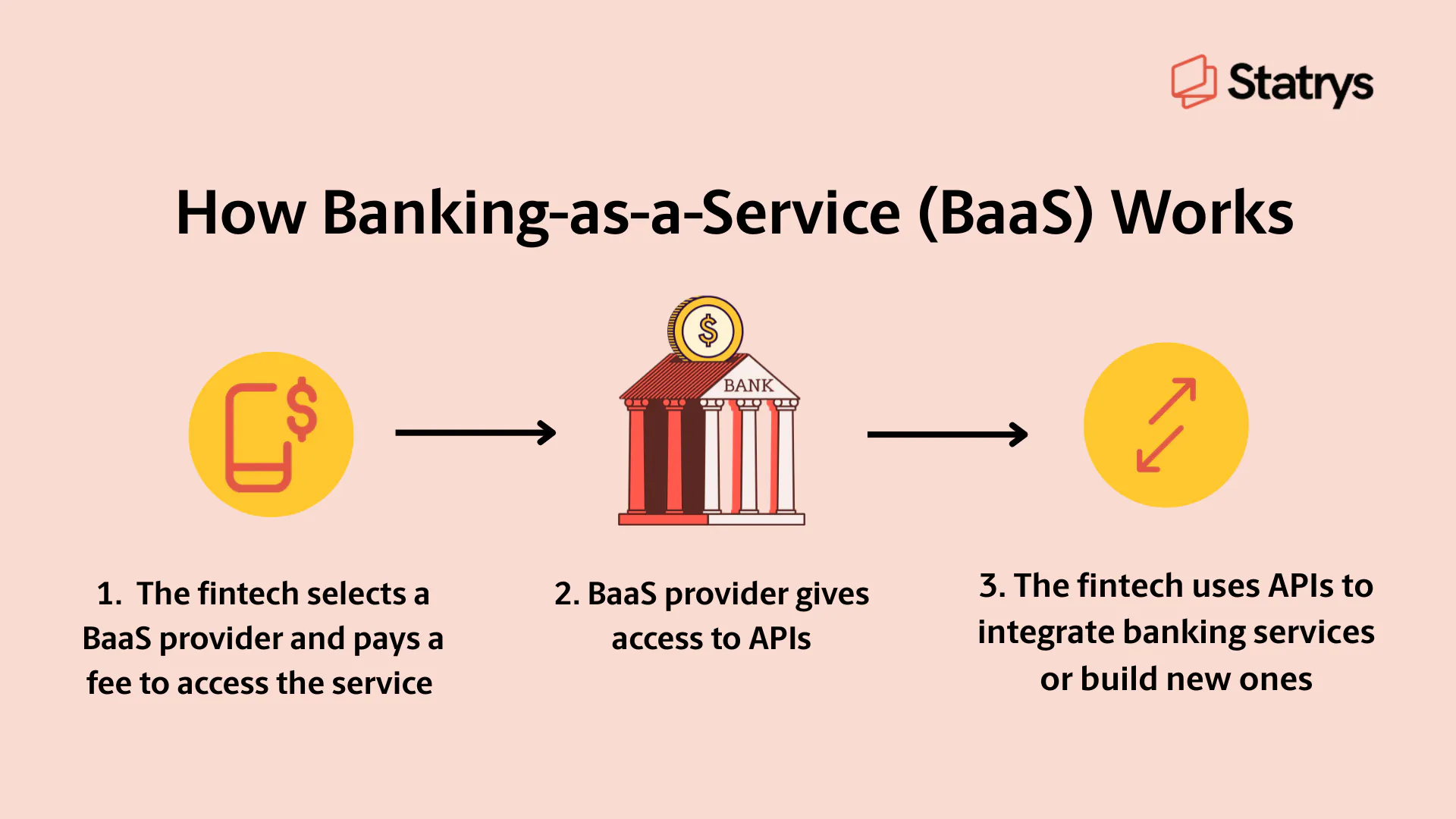
Tip: An API (Application Programming Interface) is a tool that allows different software applications to communicate and share information with each other.
BaaS offers several advantages that help businesses streamline their operations, reduce costs, and improve service offerings. Below are the key benefits of integrating BaaS into your business model:
As the name suggests, Banking-as-a-Service allows businesses to offer banking and financial products without building complex systems or handling regulations themselves. Here’s how BaaS is adding value across industries.
Banking-as-a-Service (BaaS) offers a streamlined way for new financial technology companies (fintechs) to enter the financial services market with minimal investment.
By leveraging the BaaS model and forming a partnership with a banking partner, these startups can quickly launch innovative financial solutions without needing to establish their own infrastructure or go through the lengthy process of acquiring a banking licence.
BaaS provides established banks and financial institutions with an opportunity to monetise their existing core banking ecosystem and extend their services to new customer segments. By partnering with BaaS providers, these institutions can offer financial products such as payment solutions and accounts to non-banking businesses, creating a new revenue stream while diversifying their offerings.
This model enables banks to access untapped markets, including tech companies and retailers, without significant upfront investment in new technologies or regulatory processes.
For businesses that are not in the banking or financial industries, BaaS often focuses on offering services like credit cards and debit cards to strengthen customer loyalty and generate additional revenue. For example, airlines can offer branded debit cards with loyalty points, while ecommerce platforms can provide financing options, all seamlessly integrated into their existing services.
As BaaS becomes more popular, it's important to understand how it differs from other financial service models. In this section, we’ll clarify the distinctions between BaaS, Open Banking, and Platform Banking, highlighting how each model works and who benefits from them.
While both BaaS and Open Banking involve the use of APIs, their functions differ. BaaS provides full banking services through APIs, allowing businesses to offer financial products directly on their platforms.
In contrast, Open Banking focuses on giving third-party providers access to bank data, enabling them to offer financial insights or initiate payments, but it doesn't provide the ability to issue banking products themselves.
Platform Banking is when banks integrate services from fintechs into their own offerings. For example, a bank might partner with a fintech to offer investment tools within its platform.
On the other hand, BaaS allows fintechs or non-banks to integrate banking services into their own platforms, acting as the service provider. This means that with BaaS, the fintech or non-bank handles customer-facing services while the bank provides the backend banking infrastructure.
Now that we’ve covered the fundamentals of Banking-as-a-Service (BaaS), let’s explore the next step: identifying top BaaS providers and understanding how to choose the right one for your business needs.
When selecting a BaaS provider, consider the following factors to ensure you choose one that fits your business needs:
Banking-as-a-Service (BaaS) offers businesses an efficient way to embed financial services without the need for heavy infrastructure or regulatory burdens. By choosing the right provider and integrating BaaS effectively, businesses can unlock new opportunities for growth, enhance customer experiences, and stay competitive in an increasingly digital world. Whether you're a fintech startup, an established bank, or a non-banking company, BaaS provides a flexible, scalable solution to meet your financial service needs.
Use Case 📚 |
|---|
A fintech company offers business accounts to its customers by integrating with a BaaS provider. Through an API provided by a licensed custodial bank they’ve partnered with, the fintech company can offer services like payments, account management, and loans. The bank handles all the regulatory compliance and backend operations, while the fintech focuses on customer-facing features and user experience. |
Use Case 📚 |
|---|
ClearBank, a UK-based licensed bank, uses its BaaS platform to provide white-label banking services like business accounts to fintech companies. For example, a fintech integrates ClearBank’s APIs to offer digital business accounts to its customers. While the fintech handles the customer-facing experience, ClearBank manages the banking system, ensuring compliance and security, and providing FSCS protection. |
Use Case 📚 |
|---|
Airlines such as Lufthansa and easyJet are leveraging BaaS to offer branded debit cards to customers, allowing them to earn loyalty points and access other financial services directly through the airline’s platform. Similarly, ecommerce platforms like Shopify have integrated lending options into their services, enabling customers to access financing without ever leaving the platform. |
| Provider | Key Services | Best For |
|---|---|---|
| ClearBank | Operating accounts, customer segregated accounts, multi-currency accounts, real-time payment clearing, embedded banking | New fintech companies looking for a full suite of banking services |
| Starling Bank | Businesses looking to offer bank accounts only | Businesses looking to offer bank accounts only |
| Solaris | Digital banking and account APIs, branded cards, payment flows, split-pay, consumer lending tools, onboarding and identification tools | New neobanks needing complete banking solutions or companies looking to issue their own payment cards |