HK
HK
Cash flow statements are divided into three parts: Operating Activities, Investing Activities, and Financing Activities.
Positive cash flow indicates good financial health, while negative cash flow may suggest operational challenges.
A cash flow analysis determines the inflows and outflows of cash regarding a business over a specific period. A cash flow analysis gives analysts, investors, finance teams, and executives insight into the cash inflows and outflows of any given company.
Investors conduct this analysis to determine if a company is profitable, in sound financial health, and, more importantly, if capital is worth investing in any given company. It can also help executives acquire insight into the financial environment of their company for them to make smarter business decisions to guide strategic planning.
A cash flow analysis begins by analyzing a cash flow statement. Through this analysis, an individual can identify anomalies, patterns, and trends in a business’s revenue. Understanding the nuances of cash flow is crucial for effective financial management, strategic planning, and risk assessment, making it a cornerstone in evaluating a company's overall financial well-being.
Before we begin a cash flow analysis, we have to prepare a cash flow statement. The cash flow statement is a financial statement that summarizes the movement of cash that comes in and out of a company on a monthly, bi-monthly, or yearly basis.
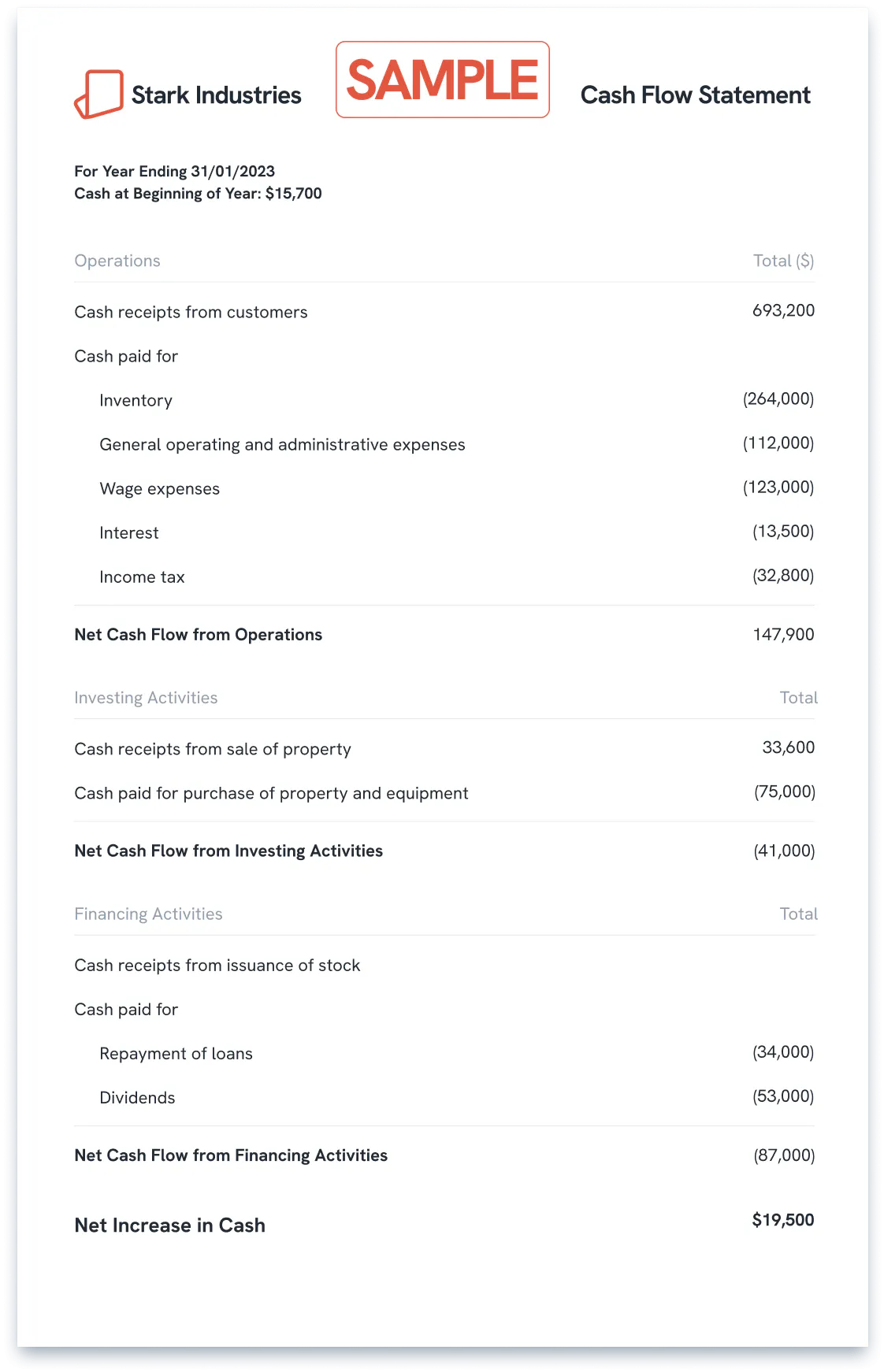
Here's an example of a cash flow statement:
This statement can help provide insight into a company’s financial health.
A cash flow statement is divided into three parts.
Net income is derived from the income statement and represents the company’s revenues minus its expenses. Net income is a key financial metric that reflects a company's profitability and is often used to assess its overall financial performance.
Cash from financing activities and cash from investing activities are commonly mixed with one another. So, to help illustrate the differences between these two, we’ll present a table explaining each aspect.
| Investing Cash Flow | Financing Cash Flow | |
|---|---|---|
| Nature of Activities | Involves long-term asset and investment activities | Deals with capital structure and financing activities |
| Objective | Aims at long-term growth and strategic investments | Focuses on raising and managing capital |
| Indicator of | Company's investment strategy and long-term planning | Company's capital structure and financial strategy |
| Key Considerations for Analysis | Evaluation of growth and strategic decisions | Assessment of capital raising and debt management |
| Impact on Cash Position | Affects the overall cash position based on the success or failure of investments | Affects the overall cash position by influencing the company's financial structure |
| Analytical Significance | Important for assessing a company's commitment to growth and innovation | Critical for understanding the company's financial health and how it manages its capital |
| Examples | • Capital Expenditures (CapEx) • Acquisitions • Sales of assets • Investments in securities • Proceeds from the sale of securities | • Issuing or repurchasing common and preferred stock • Issuing bonds or taking loans • Repaying debt • Dividends payments • Share buybacks |
It’s vital in any cash flow analysis to consider it from a business perspective. A cash flow statement can give insight into what phase a business is if they are a growing startup, a mature company, or in a declining phase.
Based on these records, a company may be influenced by business decisions such as hiring, budgeting, and business expansion plans. Here are examples of interpretations:
Without understanding the cash flow in your company, you do not know the direction, and you cannot accurately assess your financial situation, which is a dangerous position to be in with any business. There are a multitude of reasons why cash flow analysis is important, but we will name the main four in this article.
Your cash flow determines your working capital, which is the amount of cash you have on hand to operate your business. If your working capital is low, then your liquidity is also low, which means you have less cash to spare during crises or emergencies. Thorough cash flow analysis helps prevent liquidity shortages and further prepare for future economic challenges.
Using the information from a cash flow analysis, in particular, cash flow ratios, a company executive can determine the amount of risk its enterprise can take.
A company that shows cash flow problems may be less incentivized to take larger financial risks while a company that shows healthy cash flow is better equipped to take financial risks in the form of investments, expansions, and research/development.
A main benefit of conducting cash flow analysis is that it creates transparent financial reporting. Investors are more likely to invest in transparent companies that stay up-to-date with their financial reports.
Furthermore, if there are any gaps in cash flow, a company can know the areas that they need to fix to make their company more attractive to investors.
Cash flow analysis is vital in tax planning, as it helps businesses optimize their tax positions, manage liabilities, and ensure efficient use of financial resources. Cash flow projections can help in estimating and managing tax outcomes.
A cash flow analysis is commonly conducted through the cash flow statement. However, there are other ways of utilizing financial reporting to conduct a cash flow analysis.
The cash flow statement shows the ins and outs of cash flow—the most commonly used statement for cash flow analysis.
It’s possible to analyze cash flow through the income statement, also known as a P&L statement. You can calculate cash flow through what you call the indirect method. The formula will be listed below:
Net Cash from Operating Activities = Net Income + Non-Cash Expenses (e.g., Depreciation and Amortization) + Changes in Working Capital + Non-Operating Gains/Losses
A balance sheet shows three pieces of information. Assets, liabilities, and shareholder equity. To put it in simple terms, if there are more assets, it implies cash inflow. If there are more liabilities there are, it implies cash outflow. In terms of financing activities on the balance sheet, more equity (issuing stock) shows higher cash inflow, while higher debt shows a cash outflow.
You can also conduct cash flow analysis through cash flow ratios. Here are some of the more common ones:
Formula: Operating Cash Flow Ratio = Operating Cash Flow / Current Liabilities
Explanation: The operating cash flow ratio shows the liquidity available to any given company. A ratio higher than one shows a company can meet its short-term obligations.
Formula: Free Cash Flow to Equity (FCFE) Ratio = Free Cash Flow / Average Shareholders' Equity
Explanation: This ratio indicates the percentage of cash flow available to the equity shareholders after covering all expenses, capital expenditures, and debt obligations. A higher FCFE ratio suggests better financial flexibility.
Formula: Cash Return on Assets (CROA) = Operating Cash Flow / Average Total Assets
Explanation: This ratio assesses how efficiently a company is generating cash from its total assets. A higher CROA indicates effective cash generation relative to the company's asset base.
Formula: Cash Conversion Cycle (CCC) = Days Inventory Outstanding + Days Sales Outstanding - Days Payable Outstanding
Explanation: The cash conversion cycle (CCC) measures the time it takes for a company to convert its investments in inventory and accounts receivable into cash minus the time it takes to pay its suppliers. A shorter CCC is generally considered more favorable, as it implies faster cash conversion.
The biggest measure of profit used by analysts is free cash flow. A firm that has negative free cash flow indicates that the company is not profitable, while a positive free cash flow is usually a green flag for investors.
This statement excludes the non-cash expenses of the income statement while including spending on equipment, assets as well as changes in working capital.
To calculate free cash flow, you will need a measure called “capital expenditures.” Capital expenditure represents the cash spent on purchasing, upgrading, or maintaining physical assets such as property, plant, and equipment, and this metric will be deducted from operating cash flow to give you free cash flow.
The most straightforward way to calculate free cash flow is through the direct method, which goes as follows:
Free Cash Flow = Operating Cash Flow − Capital Expenditures
The indirect method is a way of calculating free cash flow by adjusting net income for non-cash items and changes in working capital. To calculate free cash flow with the Indirect method, you can use:
Free Cash Flow = Net Income + Non−Cash Expenses (e.g., Depreciation) + Changes in Working Capital − Capital Expenditures
There are certainly differences between the three metrics of operating cash flow, free cash flow, and EBITDA (Earnings before interest, taxes, depreciation, and amortization), which can be used in cash flow analysis. We’ll cover them below in this table.
| Free Cash Flow (FCF) | Operating Cash Flow (OCF) | EBITDA | |
|---|---|---|---|
| Definition | The cash generated by a company that is available for distribution to all stakeholders after necessary capital expenditures. | The cash generated or used in the core operating activities of a business. | A measure of a company's operating performance, indicating its ability to generate operating profits before considering interest, taxes, depreciation, and amortization. |
| Calculation | FCF = Operating Cash Flow - Capital Expenditures | OCF = Net Income + Non-cash expenses (e.g., depreciation) + Changes in working capital | EBITDA = Revenue - Operating Expenses (excluding interest, taxes, depreciation, and amortization) |
| Focus | Emphasizes cash available for distribution to investors and debt reduction. | Focuses on the cash generated from day-to-day operations of the business. | Highlights operating profitability by excluding non-operating expenses and non-cash items. |
| Capital Expenditures | Deducts capital expenditures from operating cash flow to arrive at the free cash available. | Does not explicitly deduct capital expenditures but includes all operating cash flows. | Does not account for capital expenditures or changes in working capital. |
| Non-Cash Items | Includes adjustments for non-cash items such as depreciation and amortization. | Includes non-cash items in the calculation, such as depreciation. | Excludes non-cash items like depreciation and amortization. |
| Purpose | Focuses on the company's ability to generate cash for future growth and shareholder returns. | Evaluates the cash-generating capability of the core business operations. | Provides a snapshot of a company's operating profitability without considering financing and accounting decisions. |
| Limitations | Can be affected by changes in capital expenditure requirements. | May not fully reflect the timing of cash receipts and payments. | Excludes important elements like interest, taxes, and changes in working capital. |
All three metrics measure different aspects of a company’s financial performance. Operating cash flow (OCF) and free cash flow (FCF) are more directly related to cash generation and usage, while EBITDA is an earnings metric that is often used in combination with other measures to assess a company's overall financial health.
Here are the steps you need to take to conduct a cash flow analysis:
Keep your cash flow statement & other financial statements up to date to have a real-time understanding of your business's cash position. Regular updates help in identifying trends and addressing potential issues promptly.
Develop cash flow forecasts to anticipate future inflows and outflows. This helps in planning for potential cash shortages and allows for proactive management.
Keep a close eye on working capital components, such as accounts receivable, accounts payable, and inventory. Efficient management of these elements can positively impact cash flow.
Negotiate favorable payment terms with suppliers and encourage early payments from customers. This can help in improving the cash conversion cycle and reducing the need for external financing.
Have a clear strategy for managing accounts receivable, including timely and proactive invoicing, offering discounts for early payments, and following up on overdue payments.
Optimize inventory levels to avoid tying up excess cash in unsold products. Implement just-in-time inventory practices to reduce carrying costs and improve cash flow.
Assess the necessity of capital expenditures and prioritize projects based on their impact on cash flow. Consider alternatives such as leasing or financing to spread the costs over time.
Be aware of various financing options, including lines of credit, small business loans, or alternative funding sources. Use these strategically to address short-term cash flow gaps.
Diversify your sources of revenue to reduce dependence on a single customer or market. This can provide stability during economic fluctuations and mitigate the impact of revenue declines.
Establish and maintain a cash reserve for unexpected expenses or downturns in business. Having a buffer can help you navigate challenging periods without jeopardizing the operation.
Conducting a cash flow analysis should provide you with a big-picture overview of your business’s financial health, casting over a period of time. However, a cash flow analysis does not account for external factors such as industry trends, economic conditions, and regulatory changes that may impact a business’s bottom line that are outside of the business owner’s control.
Therefore, it’s sound advice to say that a cash flow analysis will always be up to the interpreter conducting the analysis to take into account various factors of why a business is in its current situation and, based on the reasons, pivot a company’s direction to improve its financial health better.
Analyzing a company's financial health entails more than just reporting; it involves delving into cash flow dynamics. The subsequent step is to identify the underlying factors influencing the current state and strategically replicate successful practices while eliminating detrimental ones. This approach is crucial for steering the company towards a more stable future.