HK
HK
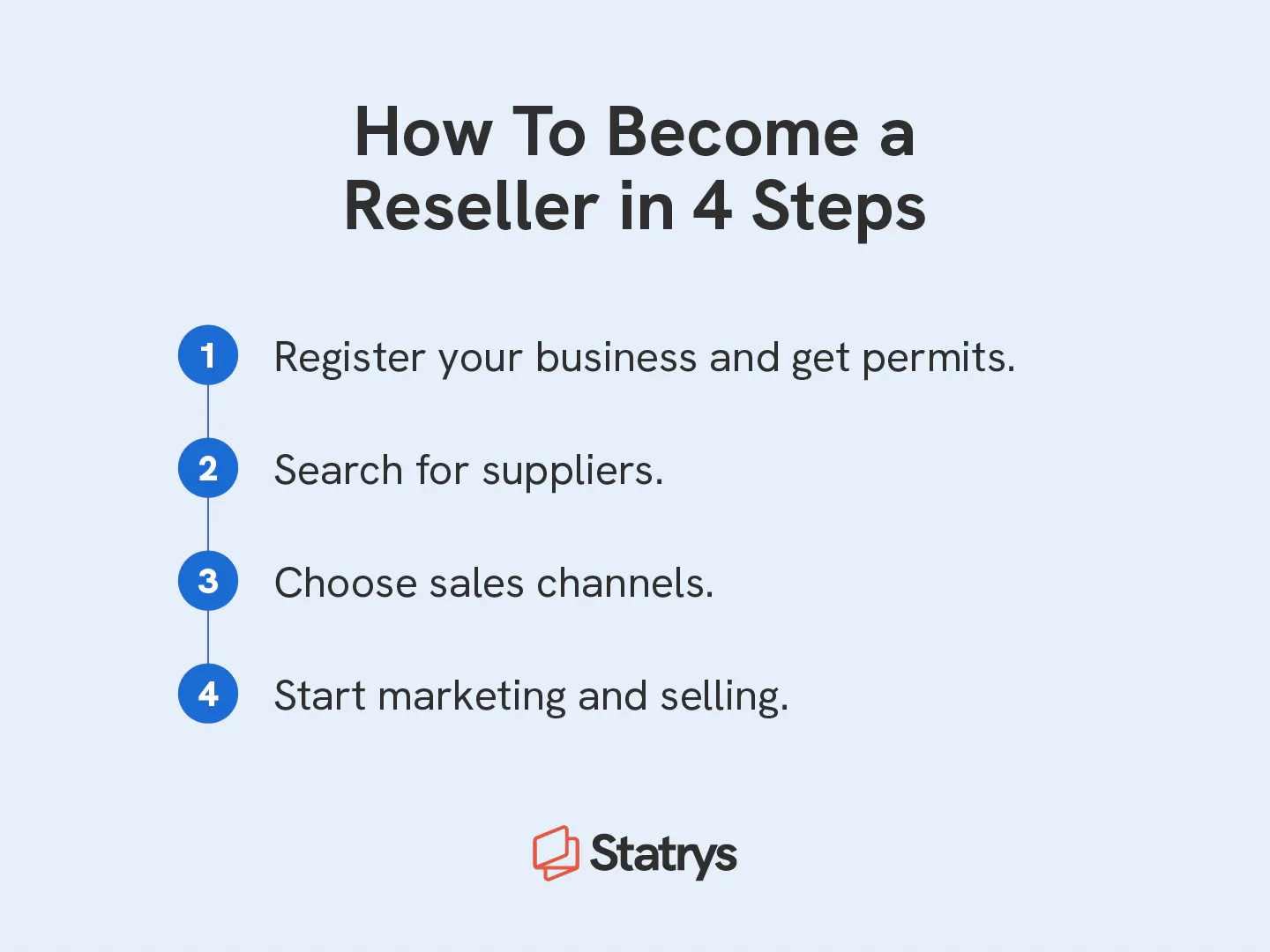
1. Register Your Business and Obtain Necessary Permits
2. Find Suppliers
3. Decide on Your Sales Channels
4. Start Marketing and Selling
If you’ve always wanted to be an entrepreneur but don’t have an idea for a new product that will change the world, reselling could be a viable business opportunity for you.
Reselling is big business. In the United States alone, the used merchandise industry is worth nearly $6.1 billion. It’s a great way to get rid of things you don’t need and it can help you learn more about an industry you want to be part of.
The work can be done full or part-time and doesn’t necessarily require a large amount of money to start.
Do we have your attention yet? Read on for more information on how to become a reseller who sells online.
A reseller is someone who buys a product from a manufacturer, distributor, or retailer and sells it to a customer.
Think of any business that sells items from more than one brand — they’re technically a reseller, whether they’re a big-box store or a dropshipper.
What sets some resellers apart from retailers is that instead of taking a generalized approach to carry many kinds of goods, a reseller might focus on and specialize in one type of product.
For example, a reseller might only sell blue jeans from two or three luxury denim brands instead of carrying many kinds of clothing.
Being a reseller also comes with some distinct advantages not available to other types of companies, such as:
It isn’t going to be an easy ride, though. Supply limitations and minimum order requirements from suppliers and manufacturers can pose a problem to resellers whether they’re just starting out or if they’ve been in business for years.
Exclusivity agreements are another hurdle you may have to navigate if you want to buy and resell new merchandise.
| Advantages and Drawbacks of Becoming a Reseller | |
|---|---|
| Pros ✅ | Cons ❌ |
| Can buy goods tax-free | At the whim of manufacturers |
| Specialize in an industry or segment of an industry | Exclusivity agreements may prevent you from selling in certain places |
| Don't have to develop or manufacture anything | Minimum orders can be very expensive |
| Provide items to customers that used to be exclusive to wholesalers | |
Want to learn how to start a resell business? Becoming a reseller is similar to opening any retail store because that’s essentially what it is.
In the next few sections, you’ll see where the subtle differences between other retailers and resellers come in and how you can use them to your advantage.
Like any other business, you’ll need to register and license your business.
In some countries, this is all done through the federal government, while others will have to go through local, county, state, and federal agencies for all required permits and licenses.
Federal requirements vary by country, but most governments will require you to be licensed so you can pay taxes and pay your employees.
To conduct business in most states, you’ll need:
Finding suppliers for your reselling business can be one of the most difficult parts of getting your company started, but it should also be one of the most fun and interesting.
Even if you’re already something of an expert in the field, getting to see how things run should be a fascinating glimpse into your new industry.
Generally, there are three main ways of finding goods to sell:
There’s really no rule of thumb as to which is better, but there are some pros and cons to consider for each. And it’s important to remember your margins and your ability to keep items in stock.
| Manufacturers | |
|---|---|
| Pros ✅ | Cons ❌ |
| No middleman markup | May require larger orders |
| Can buy tax-free | They may not work with resellers |
| Wholesalers | |
|---|---|
| Pros ✅ | Cons ❌ |
| They may work with brands you can't buy directly from | You pay a markup |
| Lower minimum orders compared to manufacturers | |
| Can buy tax-free | |
| Previously Owned | |
|---|---|
| Pros ✅ | Cons ❌ |
| Costs may be lower | Supplies are limited |
| Lower amounts of inventory mean lower overhead costs | Quality may not be the best |
| May not be able to buy tax-free | |
Whether you’re sourcing products from manufacturers in China or you’re buying from a supplier in your hometown, once you have products, you’ll need a way to sell them.
Your sales channels are the ways you’ll get products to your customers. That can mean becoming an online reseller with an ecommerce store, a brick-and-mortar location, third-party sites, or dropshipping partners.
Similar to suppliers, there is really no rule of thumb as to which is better, but there are a few pros and cons to bear in mind about each.
| Ecommerce Store | |
|---|---|
| Pros ✅ | Cons ❌ |
| Free or affordable to start | Can be difficult getting customers |
| Allows you to sell from your home | May require significant investment in ads and content marketing |
| Lets you partner with dropshipping companies | |
| Can sell worldwide | |
| Physical Storefronts | |
|---|---|
| Pros ✅ | Cons ❌ |
| Great for branding | Overhead is expensive (rent, utilities, insurance, etc.) |
| Highest margins | May require employees |
| Can only sell in these locations | |
| Third-Party Sites | |
|---|---|
| Pros ✅ | Cons ❌ |
| Large user bases | You pay the site for every item you sell |
| Buyers trust these sites | You are at the mercy of these sites' policies |
| Usually free to start selling | |
| May provide you with access to discounted postage and shipping materials | |
| Dropshipping Partners | |
|---|---|
| Pros ✅ | Cons ❌ |
| You don't have to store or ship goods | You don't have to handle returns |
| You pay more for every order | Per-order fees and order minimums can add up |
The expectations customers have about how they buy your goods will be a deciding factor in which option you choose, but don’t be afraid to take a risk and try something different if you have the data to back up your decision.
Marketing any business can be one of the most confounding and expensive parts of operating.
Luckily, there are more options for getting your name out there than ever before.
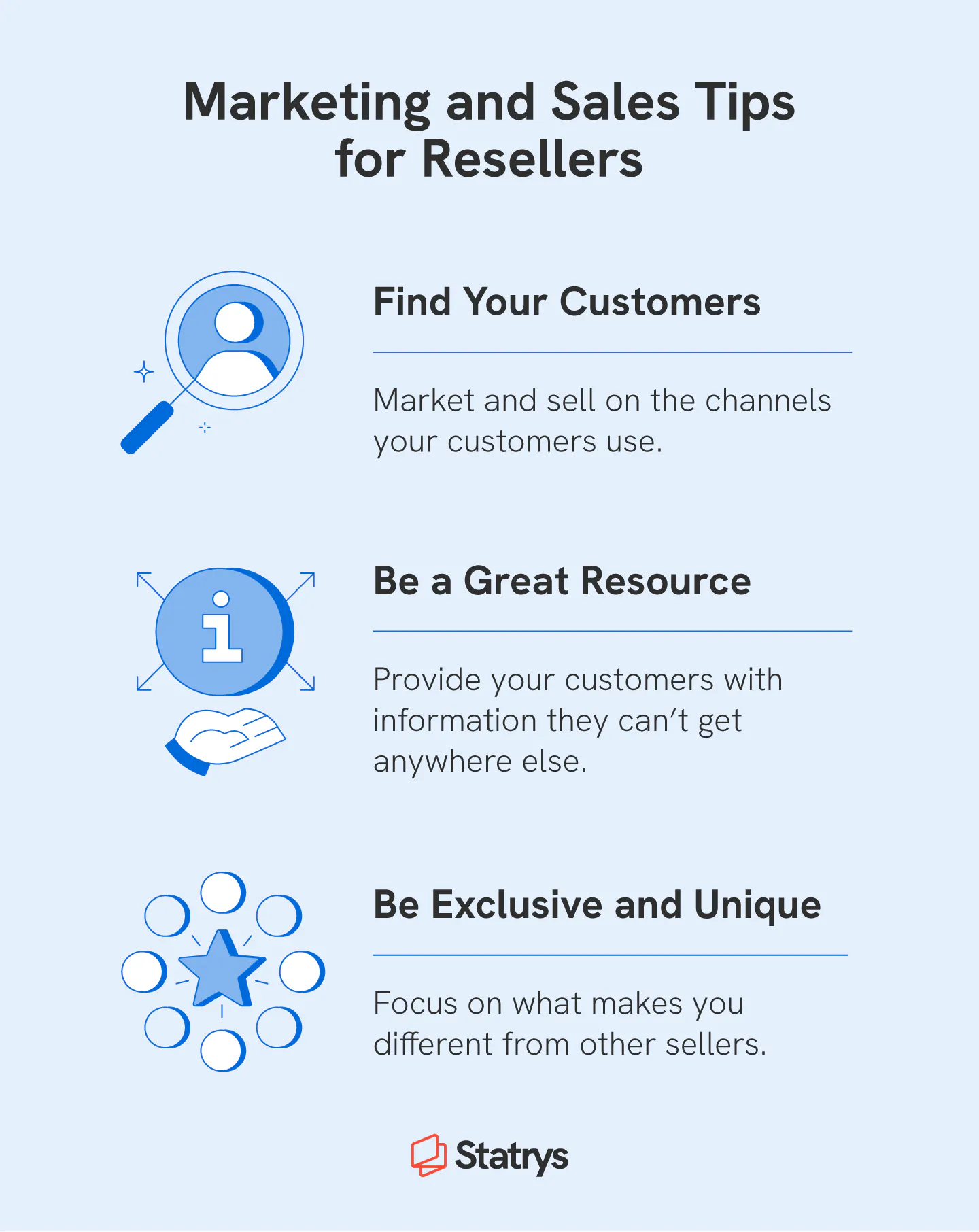
Before you start marketing, it’s important to identify which channels you’re going to use and which ones you’re going to avoid.
If you’re selling cutting-edge electronics, for example, you probably don’t want to devote a lot of money to advertising in newspapers.
The best channels are the ones your customers are using, so ask yourself these questions to get an idea of where to start:
As a reseller, you can offer a lot of things that manufacturers and big retailers can’t.
As a specialist, you know your products in ways that others don’t, so lean into that expertise in your marketing, sales, and customer communications.
Always remember to keep an eye on your margins. They can make the difference between success and failure. When you’re determining your margins, make sure you account for everything that costs you money, including:
By using your margins as the barometer of your business’s health, you’ll be more likely to make decisions that keep your business afloat.
Ready to start finding your resale suppliers? These tips will provide you with everything you need to begin your search in earnest.
Interested in becoming a reseller but aren’t sure exactly what you’d like to sell?
We put together a list of some of the most popular items to resell. If any of these pique your interest, start digging a little deeper until you find your niche.
Clothing and shoes are some of the most popular (and potentially profitable) resale businesses. The worldwide value of the secondhand clothing industry alone is expected to be $218 billion by 2026.
Find a specialty to become an authority and seller with access to what everyone wants. Here are a few niches to explore:
Everyone loves their pets, and that means that they’re willing to spend money on them. A lot of money, in fact: the value of the pet industry was more than $120 billion in the United States alone in 2021.
Want to find a way to stand out in a potentially crowded market? Think about some of these options:
Consignment is a type of reselling where you take care of the legwork of listing and selling an item for someone else and take a commission when it sells.
You can set up an online store to sell consignment, a brick-and-mortar shop, or you can sell on auction sites like eBay. A few of the most popular consignment markets are:
If you want to help people find ways to make themselves look and feel beautiful, cosmetics and beauty supplies are a great idea. The overall industry was worth more than $93 billion in 2022, which shows how important these products are to people.
A few ways of getting these products to your customers include:
Cars are big business, and so are car accessories.
People love to customize the inside of their cars to make them more stylish and comfortable, which gives you an opportunity to grab some of the estimated $16.1 billion spent in the industry each year.
Looking for ideas of what to sell? Consider these options:
People all over the world spend a ton of money on electronics.
As a reseller, you can occupy a unique place in the market. Whether you want to be an electronics seller who carries a little bit of everything or you want to be the source of one kind of gadget, the options are nearly endless. Some popular electronics for resale include:
Selling electronics gives you the opportunity to be on the leading edge of technology or to specialize in selling older technology that is still in demand.
Subscription boxes are another popular thing to resell.
Subscription boxes can be a one-size-fits-all kind of package or a singular box designed specifically for one person. These services are found in many industries, and some of the most popular include:
Recurring revenue can help you expand your product offerings by bringing on new suppliers or by adding a la carte items.
With dropshipping, you can pick from one (or many) kinds of product and then have the orders fulfilled and shipped by another company.
Depending on the drop shipper, they may also be the supplier or manufacturer, so it can be one of the easiest ways to start reselling.
With dropshipping, you can be as focused or as general as you want in terms of what you sell.
Like any business, successful reselling is about offering something consumers want at prices that let you make enough money to keep buying and selling more.
The following tips are focused specifically on ways to improve your chances of success as a reseller.
Your website is a customer’s first impression, so make sure it’s a good one! How do you put your best foot forward?
No one wants to wait for something they ordered. In fact, 22% of people will abandon a cart just because the seller doesn’t offer fast shipping.
While that might not seem fair, there are ways to overcome this potential pothole.
You’ll have to consider the pros and cons of each approach. It’s also a good idea to reevaluate your needs and options as time goes on and your business grows.
Dropshipping might be the best way to get a business on its feet, but if you start making solid sales, you may be able to ship in-house for less.
As a reseller, your margins are just as important — if not more important — than they are for other kinds of retailers.
The market can shift quickly, so you need to be prepared to get more products in stock quickly, but you also need to make sure you aren’t stuck with too much product that isn’t moving after tastes shift.
Here are a few ways to improve your margins:
Now that you’ve got an idea of what reselling is and how to become a reseller, it might be a good time to start thinking about building your own ecommerce store to start selling your products.
Setting yourself up with the right ecommerce tools can help grow your business, lower your costs, and keep you more productive, so spend some time researching the best ways to optimize your processes.