HK
HK
A deposit invoice requests partial payment — typically 25-50% of the total cost — before work begins or goods are delivered.
It is not the same as a proforma invoice. A proforma is a quote; a deposit invoice is an actual payment request.
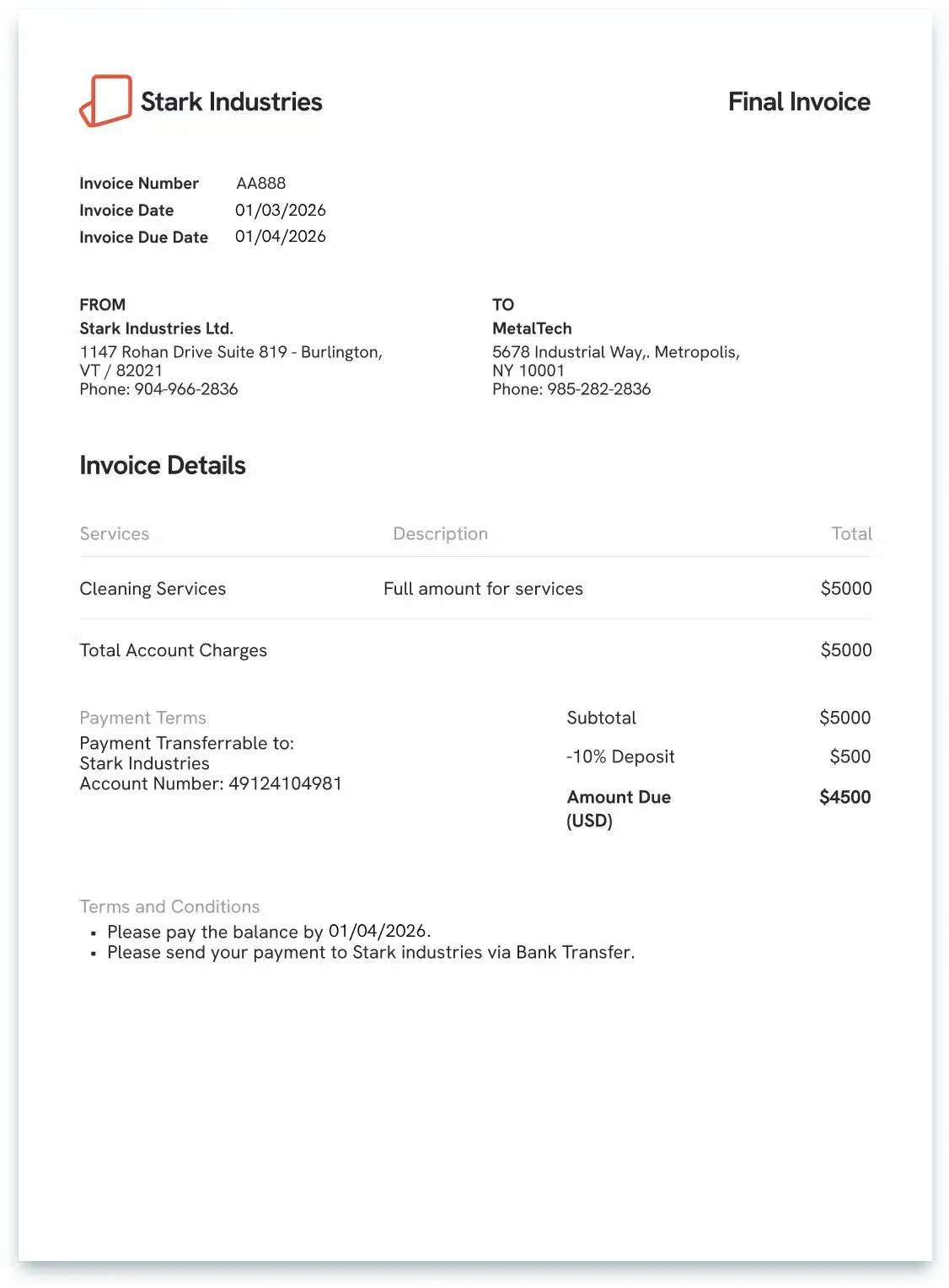
Once the work is done, you send a final invoice that subtracts the deposit from the total amount due.
Deposits protect your cash flow, reduce cancellation risk, and signal to clients that you are serious about the engagement.
A deposit invoice is how you get paid — at least partly — before you start work. If you have ever had a client cancel a large order after you had already begun, or spent weeks chasing final payment after delivery, this is the tool that prevents both problems.
This article explains what to include, how to set your deposit amount, when to use it, and how the deposit flows into your final invoice. It also includes a free deposit invoice template you can fill in and use straight away.
The research behind it draws on standard invoicing practice, publicly available tax guidance, and common invoicing software workflows.
A deposit invoice is a formal request for advance payment that covers a portion of the total project or order value. Unlike a standard invoice — which is sent after goods or services are delivered — a deposit invoice goes out before you start work.
The deposit amount is typically expressed as a percentage of the total cost (for example, 30% upfront) or as a fixed amount agreed upon with the client. Once the project is complete, you send a final invoice showing the full total, minus the deposit already paid, with the remaining balance due.
The industry has many names for the same thing: advance invoice, prepayment invoice, or retainer invoice. They all work the same way.
Here is what a deposit invoice looks like in practice:
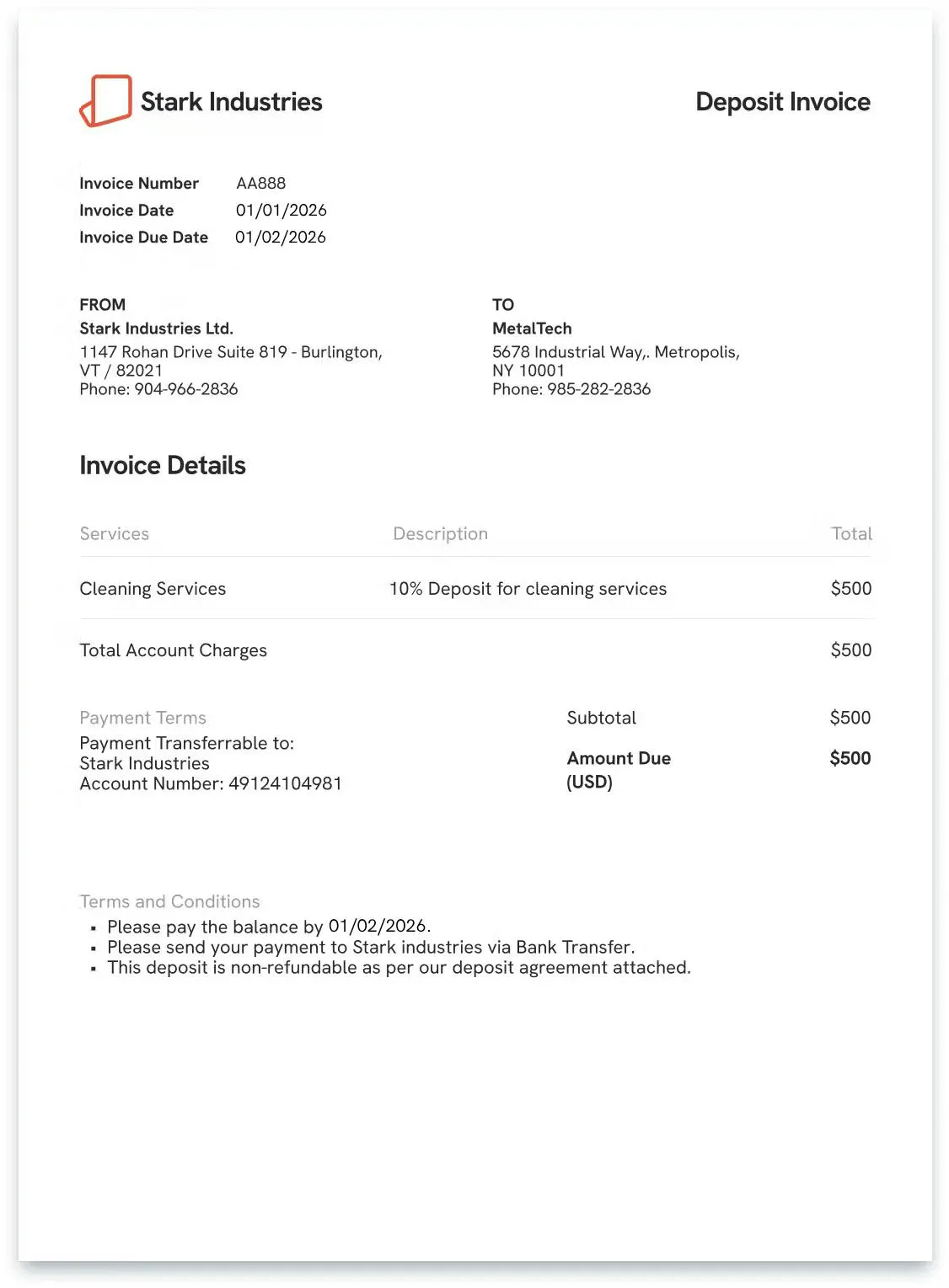
A deposit invoice and a final invoice work as a pair.
Here is how the two-step flow works:
The final invoice should always reference the original invoice number so the client can reconcile both documents easily.
These two documents are often confused but serve entirely different purposes.
A proforma invoice is a quote or estimate sent before a sale is agreed upon. It shows what the client can expect to pay, but does not request any payment. It creates no accounting entry.
A deposit invoice is a real payment request. Once sent, it creates a payment obligation. It is recorded in your accounts receivable, and the client is expected to pay by the due date.
| Proforma Invoice | Deposit Invoice | |
|---|---|---|
| Purpose | Estimate / quote | Payment request |
| Payment required? | No | Yes |
| Accounting entry? | No | Yes |
| When issued | Before agreement is finalised | After agreement, before work starts |
If you send a proforma to give the client a cost estimate and they accept, the next step is a deposit invoice — not another proforma.
Not every project needs one, but there are situations where asking for a deposit upfront is the right call — and skipping it carries a real cost.
Some projects require materials, equipment, venue bookings, or subcontractors before any billable work is delivered. Without a deposit, you are funding these costs from your own cash flow and hoping the client pays later. A deposit invoice transfers that financial risk back to the client where it belongs.
This is especially common in construction, events, catering, and custom manufacturing — any situation where significant upfront spending is required.
If a client cancels after you have already invested time and resources, a non-refundable deposit covers at least part of your loss. It also discourages casual cancellations — clients who have already paid are significantly more likely to follow through.
Common situations where this matters: made-to-order goods that cannot be resold, wedding or event bookings, bespoke design projects, and long-lead-time manufacturing.
Asking for a deposit upfront is a professional standard, not an insult. A client who pushes back hard on a standard 30-50% deposit is giving you useful information early. Established, serious clients typically accept reasonable deposit terms without friction.
Freelancers working with a new client for the first time should almost always require a deposit. The deposit acts as a basic trust signal on both sides.
The figures below reflect common practice across industries — not official statistics.
Use them as a starting point; your client's expectations and project specifics may shift them.
| Context | Commonly used deposit range |
|---|---|
| Freelance design, writing, photography | 25-50% |
| Construction and renovation | 10-30% (often milestone-based) |
| Events and catering | 25-50% |
| Custom manufacturing | 30-50% |
| Consulting retainer | 50-100% (monthly) |
| High-value goods (custom orders) | 50% |
For projects where your costs are front-loaded — materials, bookings, subcontractors — set the deposit to cover at least those specific costs. For service-based work, 30-50% is a widely accepted starting point.
If you use progress invoicing (billing at multiple stages of a long project rather than just at the start and end), the first milestone payment functions as your deposit. In that case, structure each milestone as a separate invoice rather than a single upfront payment.
A deposit invoice should contain the same core fields as a standard invoice, with the addition of clear deposit-specific terms.
| Field | What to include |
|---|---|
| Your business name and contact details | Name, address, email, phone |
| Client's information | Client name, company, billing address |
| Invoice number | A unique reference number for your records |
| Issue date | The date the invoice is sent |
| Due date | When the deposit payment is expected |
| Description of work or goods | Clear description of what the deposit covers |
| Total project cost | The full agreed amount for the engagement |
| Deposit amount | The specific amount requested now (e.g. 30% = $1,500) |
| Remaining balance | What will be owed on completion |
| Payment methods | Bank transfer details, credit card, or other accepted methods |
| Payment terms | Any late fees, cancellation terms, or refund policy |
| Sales tax | If applicable, show tax on the deposit amount separately |
Show the full project cost first, then the deposit amount as a line item below. This makes it easy for the client to see exactly what they are paying now and what will be owed on completion.
Here is what that final invoice looks like — the $500 deposit is deducted from the $5,000 total, leaving $4,500 due:
Use this email template when sending your deposit invoice to a client. Replace the bracketed fields with your own details.
Subject: Deposit Invoice — [Project Name] — [Your Company Name]
Hi [Client Name],
Thank you for confirming the project. As discussed, I require a deposit of [amount or percentage] before we get started.
Please find the attached deposit invoice ([Invoice Number]). Payment is due by [due date] via [payment methods — bank transfer / credit card / etc.].
Once I receive the deposit, I will begin work on [project name] as agreed. The remaining balance of [amount] will be invoiced on completion.
If you have any questions, feel free to reach out at [contact details].
[Your name]
[Company name]
A deposit invoice only works if you send it consistently and follow it through. These four habits make the difference.
The window between a verbal agreement and a signed commitment is where deals fall apart.
Sending your deposit invoice within hours of the agreement keeps momentum going and signals professionalism. Waiting days gives the client time to reconsider.
Decide upfront whether your deposit is refundable or non-refundable — and put it in writing on the invoice. For service work, non-refundable deposits are widely used in practice. Enforceability depends on how clearly the terms are stated and your specific jurisdiction, so if you are dealing with a large or complex project, a signed agreement is strongly recommended before any work begins.
If you are working with substantial deposits, clearly document the cancellation terms in a written agreement that the client signs. This protects both parties and avoids disputes later. A brief reminder of the policy in the deposit invoice email is also useful.
In the US, sales tax is administered at the state level. Whether you charge sales tax on a deposit depends on your state and whether you are selling taxable goods or services. Rules vary significantly between states and between product and service categories.
For the federal income tax treatment of deposits — for example, whether a non-refundable deposit is taxable income when received — refer to IRS Publication 538 (Accounting Periods and Methods), which covers when and how different types of income are recognised. For state-level sales tax rules, check your state's department of revenue directly, as there is no single federal source.
As a practical rule, apply the same tax rate to the deposit that you would apply to the full invoice. If you are unsure, ask your accountant before you send the first invoice.
Once you have the deposit and are delivering the work, it is easy to lose track of the final payment timeline. Set a reminder in your calendar or use your invoicing software to send an automatic payment reminder a few days before the final invoice is due. If you regularly deal with slow payers, read our guide on chasing outstanding invoices for a step-by-step approach.
For ongoing cash flow management, combining deposit invoices with a consistent follow-up process is one of the most practical ways to reduce payment gaps.