HK
HK

If you are hiring mid-skilled foreign staff in Singapore, or you are a professional planning to work here, the S Pass is the main permit you need to know.
In this guide, we’ll explain what the S Pass is, who qualifies, how the application process works, and what it means for family eligibility and future residency.
Let’s dive in.
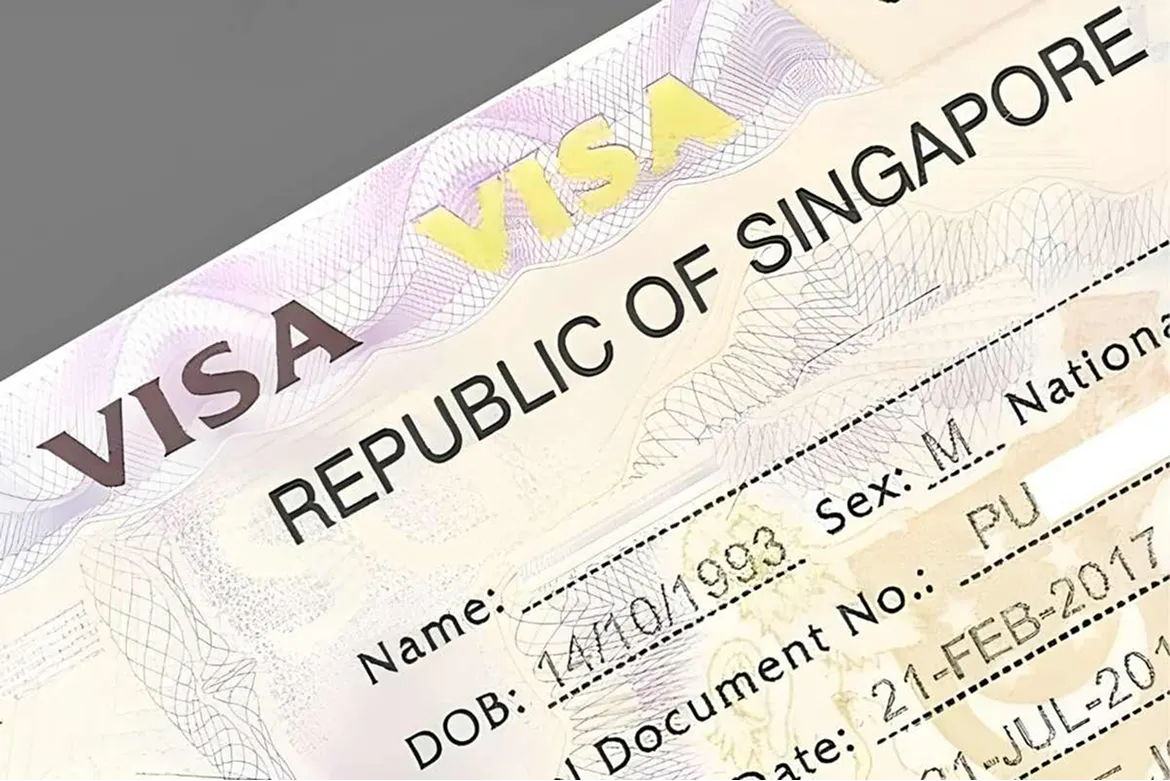
The S Pass is a work visa that allows mid-skilled foreign staff to work in Singapore. It is mainly for Associate Professional and Technician (APT) roles, jobs that require technical skills but don’t meet the salary threshold of the Employment Pass.
Examples include engineering technicians, IT support staff, life science technicians, transport supervisors, and building or safety inspectors.
Every S Pass application must be filed by the employer or a licensed Employment Agency. Employees cannot apply on their own. If the hire changes jobs later, the new employer must submit a fresh application.
Good to Know: Most employers must advertise the role on MyCareersFuture for at least 14 days before applying. This is part of the Fair Consideration Framework (FCF) that makes sure locals are fairly considered before hiring from abroad.
It also helps to see where the S Pass sits compared to other passes, especially if you are deciding which one fits your hire:
Note: Holding an S Pass does not guarantee Permanent Residence, but you can apply through the Immigration & Checkpoints Authority (ICA). Approval depends on wider factors such as your family profile and contributions to Singapore.
To get approval for an S Pass, it is not just about sending in an application. Employers need to meet the Ministry of Manpower’s (MOM) rules on salary, quotas, and levies. Unlike the Employment Pass, academic qualifications are not the main factor. What MOM really looks at is whether the salary and role match the industry standard.
From 1 September 2025, your worker’s salary has to meet MOM’s new benchmarks to qualify for an S Pass. The amount depends on both sector and age:
| Sector | Age 23 (entry-level) | Age 45+ (experienced) |
|---|---|---|
| All sectors (except financial services) | SGD 3,300 | SGD 4,800 |
| Financial services | SGD 3,800 | SGD 5,650 |
These figures rise with age because MOM expects more experienced staff to earn higher pay.
Salary isn’t just about qualifying. It also decides whether your employee can bring their family. At SGD 6,000 a month, they can sponsor a spouse and children. At SGD 12,000, parents can join too.
Tip: Always check MOM’s Self-Assessment Tool (SAT) before you apply. If it says “eligible,” your chances are good. If it says “not eligible,” the application will almost always be rejected.
Meeting the salary benchmarks is only part of the picture. Employers also need to follow MOM’s quota rules, which limit how many S Pass holders you can hire based on the size of your local workforce.
On top of that, you must pay a monthly levy for every S Pass holder, which adds to overall hiring costs.
| Sector | Quota | Levy (per month) |
|---|---|---|
| Services | 10% of total workforce | SGD 650 |
| Manufacturing, construction, process, marine | 15% of total workforce | SGD 650 |
Note: Levies must be paid by the 17th of the following month. Late payment doesn’t just lead to fines. MOM can also cancel passes or block your company from hiring new foreign staff.
Here’s how the process works, step by step.
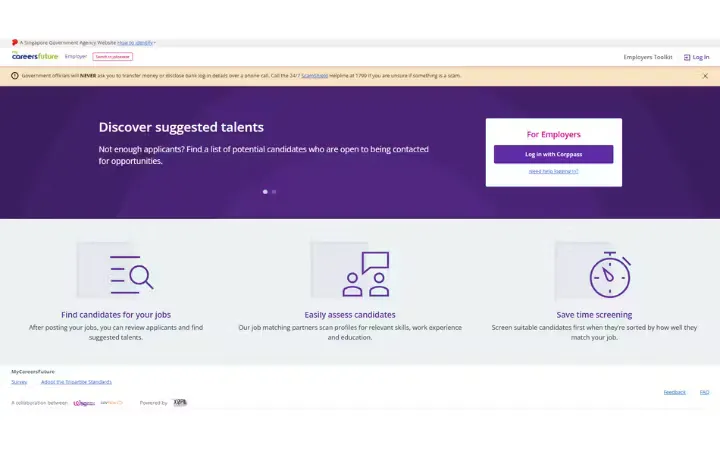
Step 1: Post the job ad
Put the role on MyCareersFuture for 14 consecutive days under the Fair Consideration Framework (FCF). Skipping or cutting this short is one of the top reasons applications get rejected.
Step 2: Prepare documents
Next, gather the basics, including your company’s ACRA profile, the candidate’s passport details, and any sector-specific licences. Certificates must come from accredited schools and be translated into English if needed.
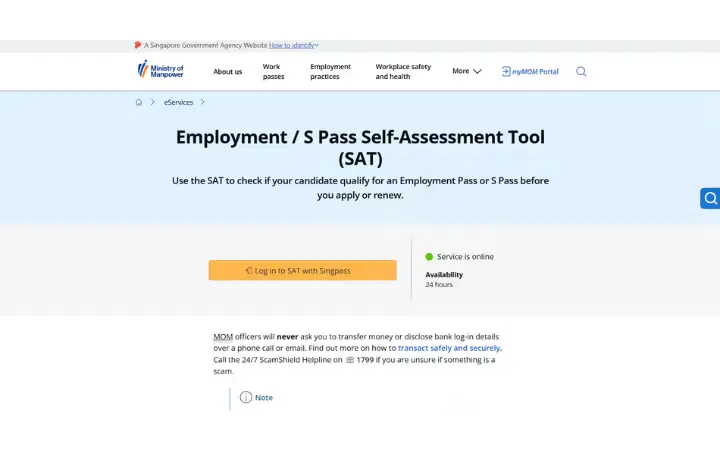
Step 3: Check eligibility
Before you spend time applying, run the candidate’s details through MOM’s Self-Assessment Tool (SAT). If the SAT says “not eligible,” the application will almost always be rejected.
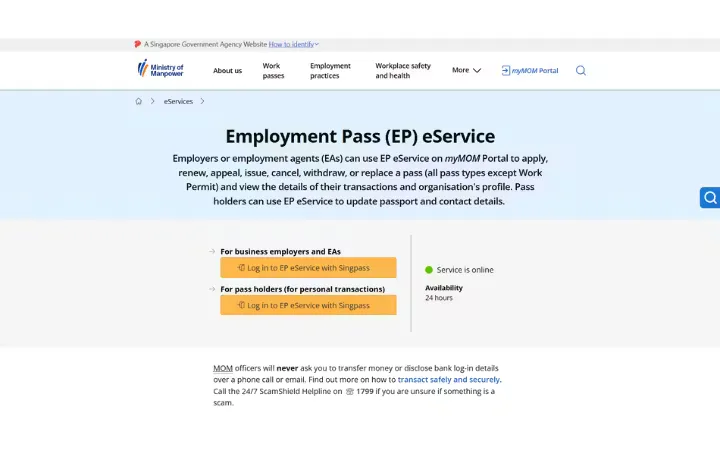
Step 4: Submit the application
Once you are confident, apply online through MOM’s EP eService. The fee is SGD 105 (non-refundable). Double-check salary figures and personal details because even small typos can cause delays.
Step 5: Wait for the outcome
Most applications are processed within 10 business days. If you are applying from overseas without a Singapore entity, expect up to 8 weeks.
Note: If your application gets rejected, you have 3 months to appeal, but only if you can provide new information, such as corrected paperwork or a revised salary. Most appeals are processed within 6 weeks.
Step 6: In-Principle Approval (IPA)
If the application is successful, download the IPA letter and send it to your candidate. It is valid for 60 days and also works as a single-entry visa if needed.
Step 7: Arrange insurance
Employers must provide medical insurance with at least SGD 60,000 annual coverage before issuing the pass.
If the employee works in construction, marine, or process sectors, or lives in a dormitory, the employer must also arrange a Primary Care Plan (PCP).
Step 8: Issue the pass
Submit the final details online, pay the issuance fee of SGD 100, and you will receive a notification letter.
This letter will tell you if the candidate needs to register biometrics (fingerprints and photo) at the MOM’s Services Centre. If required, they must do this within 1 week.
Step 9: Collect the pass card
The pass card is usually delivered within 5 working days. If biometrics are required, delivery will take place after registration. If not, it will be delivered once MOM verifies the documents.
While waiting, employees can use the digital work pass in the SGWorkPass app, which is available immediately for travel and verification.
Note: S Passes can be renewed up to 6 months before expiry, usually for up to 3 years depending on the worker’s passport validity. Employers must still meet all MOM rules on salary, quota, and insurance.
The S Pass helps employers hire mid-skilled foreign staff while keeping local hiring a priority.
For employers: Success depends on meeting MOM’s rules, such as salary benchmarks, quota limits, levies, and insurance.
For employees: Prepare genuine documents and remember that income levels determine whether family members can join.
Handled correctly, the process is straightforward and avoids costly delays or rejections.