HK
HK
1.
Research manufacturers
2.
Contact manufacturers with questions
3.
Get quotes
4.
Request and evaluate samples
5.
Sign a contract and place an order
6.
Monitor progress and evaluate finished products
Have you been working on a new product idea that you’re ready to bring to market, but you aren’t sure how to find manufacturers? You’re not alone. A Harvard Business School professor estimated that more than 30,000 new consumer products launch every year. That means there are plenty of manufacturers that can turn your idea into a reality — but that doesn’t mean they’re all going to be a good fit.
In this guide, you’ll learn how to find, evaluate, and partner with a manufacturer either in your country or abroad. Whether you need to find a Chinese manufacturer that can handle large orders or you want to work with a domestic factory, this article will help you get started.
The process takes some time, but it’s pretty straightforward:
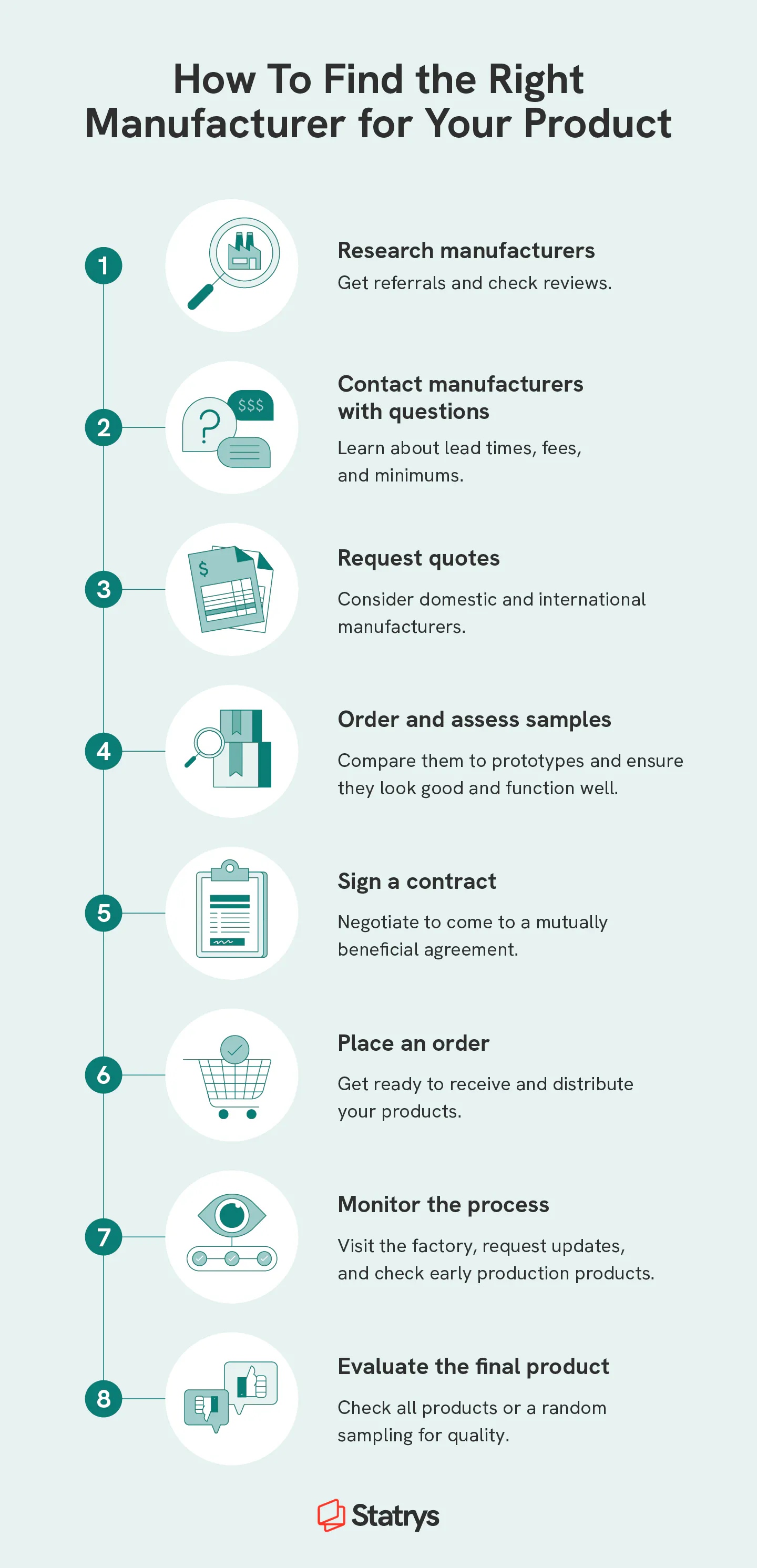
Researching manufacturers is the first step in bringing your idea to market. It can be a long and complex process finding the right fit because you’ll need one that can meet all your requirements— from physically manufacturing your products to packaging and shipping them.
There are several ways to start researching manufacturers, including via:
Here are some platforms where you can find manufacturers. It's important to review the manufacturer carefully before making a decision.
| Resource | Industries Served |
|---|---|
| Maker’s Row | Packaging, home decor, furniture, apparel, and accessories made in the US |
| GSS | Household goods, consumer electronics, pets, fitness and health, textile and apparel, toys, and automotive |
| Thomasnet | Over 6 million industrial and nonindustrial products in the US |
| Alibaba | Multiple categories Alibaba is a popular platform that helps you find ready-made products or work with manufacturers, primarily located in China, to develop custom items. The platform is popular for ecommerce and dropshipping |
| Indiamart | Multiple categories IndiaMART is the largest online directory and marketplace in India, helping manufacturers, suppliers, and exporters connect and conduct trade with one another. |
| Global Sources | Multiple categories Multichannel B2B online marketplace and sourcing platform that connects buyers with verified suppliers and manufacturers. |
| Make it British | A website that lists British manufacturers by category. |
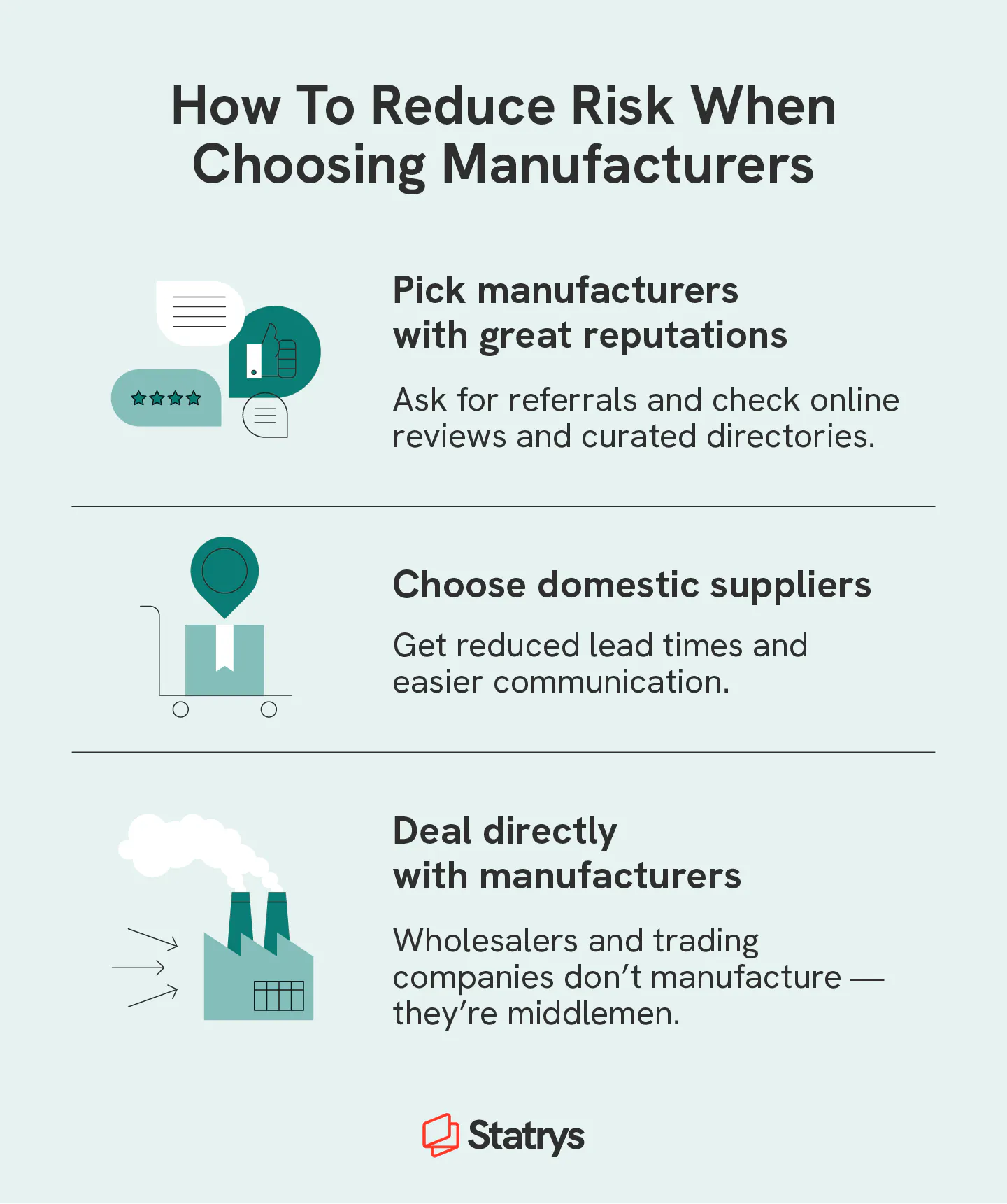
Choosing the right manufacturer also depends on the specific product category you're dealing with. Furthermore, identifying red flags and risks is another important part of your research. While there’s no guarantee that even the most reputable companies will deliver perfect products, reputation is a good indicator of what you’ll get. Here are a few tips for evaluating suppliers:
Once you have a few manufacturers you think could work, it’s time to reach out to learn more.
Your first contact with manufacturers should be as direct as possible to show that you’re serious and that you understand how the process works. It’s better to send an email than to call, but if you can’t figure out who to email, reach out by phone for some guidance.
The questions you should ask will vary depending on your unique needs, but here are a few to get you started.
Your first email is not the time to share your designs with potential manufacturers. They should be able to answer most, if not all, of these introductory questions without needing to know every detail of your items.
After you’ve received responses from prospective manufacturers, choose the ones that seem like the best fit and request quotes. During this stage, you may need to share your designs or prototypes with the manufacturer in order to get an accurate quote.
But beware — sending designs to suppliers, especially if you have unique and proprietary designs, increases your chances of intellectual property theft, so be very selective about who you share your designs with. If necessary, see if the manufacturer is willing to sign a confidentiality agreement before you send them the designs.
Some manufacturing companies offer product development services like prototyping and 3D modelling, but these can be expensive. To reduce costs, use sketches, written instructions, or reference photos to convey your ideas. Alternatively, hire industrial designers, product designers, or CAD experts, or work with a local designer for prototypes and custom moulds.
Evaluating quotes is important, so take your time. A few elements to look for include:
It's best to compare multiple quotes and find the right balance between cost and quality. This ensures you're offering a product that satisfies your customers while still allowing for a profitable margin. It's important not to sacrifice high-quality production just to lower costs.
Tip: We recommend obtaining at least three quotes to evaluate your options.

After reviewing the quotes from prospective suppliers, choose the ones that seem like the best fit and request samples from them. Many manufacturers charge for samples, but they often deduct the cost from your first order.
Once you receive the samples, inspect them to ensure they meet your expectations. Check that they look and feel right and that they function appropriately. Comparing them directly to your plans and prototypes can help you distinguish between manufacturing issues and problems with the design.
If you need to make changes, be as specific as possible when communicating with the manufacturer. If you have to update components or a part of the overall design, send them the new plans and prototypes to avoid any confusion about which version will go to the production process.
If you’re satisfied with the sample quality, keep them safe as a reference for the full production run. Address any significant differences promptly and follow the agreed-upon process with the manufacturer when finalising the contract.
Tip: After reviewing samples, you can still negotiate payment terms or MOQ. However, focus on building a long-term, mutually beneficial relationship rather than just pushing for the lowest price.
Once everything is ready, you should start finalising the contract. Working with a manufacturer is a collaboration, so try to compromise where you can without affecting your vision or standards. If you get to this stage and the supplier is unwilling to be flexible on contract terms, you can always consider other options.
Whether you’re writing a contract or the manufacturer has sent a contract, it’s a good idea to work with an attorney who has experience in your industry or with manufacturing. An attorney can help make sure your IP and investment are protected.
Some key items to include in a contract are:
Once both parties agree and sign the contract, manufacturing can begin.
As production goes into full swing, stay in touch with your manufacturing partner for progress updates. Find out how they want to communicate during this time so you aren’t causing delays. If you plan a site visit, arrive ready to evaluate products. Keep the lines of communication open with your team members in case you need their expertise while you’re on a site visit.
If early production samples were part of your contract, check them as soon as they arrive for any problems that need to be corrected before the entire run is completed. If there is a problem, follow the process laid out in the contract for correcting them.
When you receive the full order, inspect each item or take a random sample to check for any issues.
Where you source your products is a big decision, and it starts with choosing domestic or international manufacturers. Both options have their pros and cons, so you’ll need to dig deep to find a supplier that will help you strike a balance between low per-unit prices and high product quality.
Here’s a quick comparison between domestic and overseas manufacturers:
| Criteria | Domestic Manufacturers | Overseas Manufacturers |
|---|---|---|
| Cost | Costs vary depending on the country, influenced by factors like labor rates, regulatory requirements, and raw material expenses. | In countries like China, India, or Vietnam, production costs are generally lower thanks to their economies of scale. |
| Production capacity | The production capacity is shaped by the country's infrastructure, technological capabilities, and market demand. | Depending on the country. Countries with a well-established manufacturing sector, such as China, have vast production capacities. |
| Communication | Easy to communicate and visit the manufacturing site | Possible language barriers, harder-to-visit site |
| Production Speed | Fast shipping, quicker turnaround times | Longer lead times due to distance |
| Product Variety | Limited options, depending on the resources in the country | Many manufacturers to choose from |
| IP Protection | You should be able to impose strong IP protection according to your country’s law | Enforcing IP protection across countries can be more complicated |
| Supply Chain Flexibility | More predictable, easier to manage | Longer shipping times, subject to international delays |
| Risk of Currency Issues | No currency exchange issues | Risk of currency exchange problems |
| Freight Costs | Generally lower shipping costs | May be more expensive due to longer distances |
In some cases, producing some goods domestically and others internationally can help you keep costs down while keeping quality high. While this does require more careful planning, the benefits could make it worthwhile.
For example, if you’re an entrepreneur or a business owner in the USA, importing components from China to be assembled in the United States gives you more oversight over the quality of the finalised product for a much lower price than having your goods produced solely in the US.
Tip: If you're working with local manufacturers, we recommend arranging a tour of their facilities or visiting their office to get an inside view of their operations.
Manufacturers and suppliers serve distinct functions within the supply chain. Manufacturers produce finished products, such as apparel or electronics, by converting raw materials into market-ready goods that are sold to retailers, wholesalers, or directly to consumers. For example, a clothing manufacturer would craft garments by cutting fabric and adding components like zippers and buttons.
In contrast, a supplier is a broader term that refers to any entity providing products or inventory. While all manufacturers are technically suppliers because they supply goods to businesses, not all suppliers are manufacturers. Suppliers can also include wholesalers or distributors who don't produce goods but offer them as inventory for sale.
Selecting and working with a manufacturer comes with risks that can impact your business. Here are key issues to consider:
| Issue | Solution |
|---|---|
| Quality Control Issues: Inconsistent quality control can lead to defective products, customer dissatisfaction, and brand damage. | Set clear quality control standards and conduct regular audits and inspections to maintain product quality. The contract should also specify actions for defective products, including replacement or refund, and whether the seller covers return shipping costs. |
| Supply Chain Disruptions: Delays in production or shipping, particularly from overseas suppliers, can disrupt the timely delivery of goods. | Consider sourcing from multiple reliable manufacturers or nearshoring to reduce risks and ensure consistent delivery schedules. |
| IP Protection: Intellectual property laws can be complicated, especially in certain regions. This increases the risks of counterfeiting or misuse of your proprietary designs and information. | Use strong contracts, including non-disclosure agreements, non-compete agreements and more. |
| Communication Barriers: Language differences, time zone issues, and cultural misunderstandings can cause miscommunication and delays in production. | Use translation tools or hire translators to reduce errors and improve efficiency. |
| Hidden Costs: Unexpected expenses like shipping, customs, tariffs, and exchange rate fluctuations can strain your budget. | Identify and account for all hidden costs (e.g., tariffs, shipping) in advance to avoid budget surprises. |
| Location & Logistics: The manufacturer’s location affects lead time, shipping costs, and logistics, which can impact the efficiency of your operations. | Choose manufacturers closer to your target market to reduce shipping times and costs, and make it easier to oversee production. |
| Payment Challenges: International transactions may be substantial and may involve delays due to currency fluctuations, fees, and complex payment processing. | Use platforms designed for international transfers for smoother, faster, and more cost-effective payments. A provider with multi-currency accounts and FX options can be highly beneficial. |